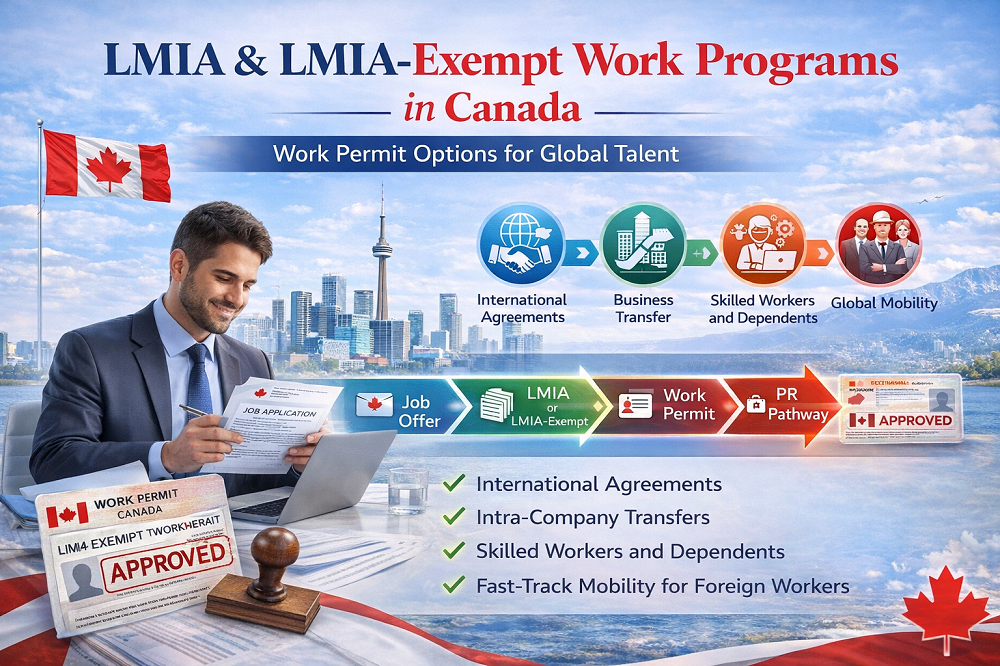
Canada offers several work permit pathways that allow foreign nationals to work legally in the country. In many cases, employers must obtain a Labour Market Impact Assessment (LMIA) before hiring a foreign worker.
However, there are also a number of programs that allow foreign nationals to work in Canada without requiring an LMIA. These programs are known as LMIA-exempt work programs and are typically managed under Canada’s International Mobility Program.
At LB Pathway, together with LandBird Law Firm, we assist skilled professionals and employers in navigating Canadian work permit programs, including LMIA-based and LMIA-exempt pathways.
What is a Labour Market Impact Assessment (LMIA)?
A Labour Market Impact Assessment is a document issued by Employment and Social Development Canada that evaluates whether hiring a foreign worker will have a positive or negative impact on the Canadian labour market.
A positive LMIA confirms that:
- No Canadian citizen or permanent resident is available for the job
- Hiring a foreign worker is necessary to fill the position
- The employer is offering fair wages and working conditions
In most employer-specific work permit applications, a valid LMIA is required before the foreign worker can apply for a Canadian work permit.
What are LMIA-Exempt Work Programs?
In certain situations, Canadian immigration rules allow employers to hire foreign workers without obtaining an LMIA. These LMIA-exempt work permits are generally issued under the International Mobility Program (IMP).
LMIA exemptions are granted when hiring a foreign worker provides broader economic, cultural, or social benefits to Canada, or when reciprocal employment opportunities exist for Canadians abroad.
Although the LMIA requirement is waived in these cases, foreign workers usually still need to apply for a Canadian work permit.
Common LMIA-Exempt Work Permit Categories
Canada provides several LMIA-exempt pathways for temporary foreign workers.
International Agreements
Foreign workers may qualify for LMIA exemptions through international agreements such as trade agreements or reciprocal employment programs.
Examples include agreements that allow professionals, investors, and traders to work in Canada under specific conditions.
Intra-Company Transfers
Employees of multinational companies may be transferred to a Canadian branch, subsidiary, or affiliate of the same organization without requiring an LMIA.
These workers are typically executives, managers, or individuals with specialized knowledge.
Significant Benefit to Canada
Foreign nationals whose work is expected to provide significant economic, cultural, or social benefits to Canada may also qualify for an LMIA exemption.
This category may include entrepreneurs, innovators, and highly skilled professionals in specialized fields.
Spouses and Dependents of Skilled Workers
Spouses or common-law partners of certain skilled foreign workers may qualify for open work permits without requiring an LMIA.
These permits allow family members to work for almost any employer in Canada.
Charitable and Religious Workers
Foreign nationals working for recognized charitable or religious organizations may also be eligible for LMIA-exempt work permits if their activities align with the organization’s mission.
Benefits of LMIA-Exempt Work Programs
- Faster hiring process for Canadian employers
- Reduced administrative requirements
- Access to specialized global talent
- Greater flexibility for workers and employers
- Potential pathway to permanent residence
These programs help Canada remain competitive in attracting international professionals and support economic growth across key industries.
Application Process
Applying for an LMIA-exempt work permit typically involves the following steps:
- Determine eligibility under an LMIA-exempt category
- Receive a job offer from a Canadian employer
- Employer submits the job offer through the Employer Portal
- Foreign worker applies for a work permit
- Provide biometrics and supporting documents if required
Even though the LMIA requirement is waived, applicants must still meet all immigration requirements to obtain a Canadian work permit.
Pathway to Permanent Residence
Many foreign workers who enter Canada through LMIA-exempt work programs later pursue permanent residence through programs such as:
- Express Entry – Canadian Experience Class
- Provincial Nominee Programs (PNP)
- Atlantic Immigration Program
Canadian work experience gained through these programs can significantly improve an applicant’s immigration profile.
How LB Pathway & LandBird Law Firm Can Help
Canada’s immigration system includes numerous work permit categories, each with its own eligibility requirements and application procedures.
Our team provides professional guidance to help individuals and employers navigate LMIA and LMIA-exempt work programs.
- LMIA and LMIA-exemption eligibility assessments
- Work permit application preparation
- Employer recruitment support
- Immigration strategy planning
- Legal guidance through LandBird Law Firm
Start Your Work Journey in Canada
Canada’s LMIA and LMIA-exempt work programs provide opportunities for skilled professionals from around the world to contribute to Canada’s economy.
Contact LB Pathway today to learn how you can explore Canadian employment opportunities through the right work permit program.